Skep Succumbs to Peer Pressure from People on the Internet and Bakes a Coconut Layer Cake
This comment was left in response to me trying the Pepperidge Farm Frozen Coconut Layer Cake:

(p7uen: Mary Berry would like a word with Mr. Farm about his flavourless sponge: https://maryberrycooks.co.uk/mary-berry-coconut-cake/)
The link goes to a page with a recipe for coconut cake, attributed to the noted British chef Mary Berry. A quick scan of the recipe revealed that overall, it was fairly straightforward and didn’t require any unusual ingredients or odd techniques that would be inaccessible to me. I knew that for the sake of comparison, I had to give this recipe a try—and my annual Virtual Potluck would be the perfect time to do it.
Of course, it wouldn’t be worth doing without thoroughly documenting the process.
Friday
An important part of this recipe—the most important part, some might argue—was the desiccated coconut, which I need for both the cake and the icing. I’m sure I could have just bought some form of prepared coconut, but I’m apparently the kind of person who loves to make more work for myself, so I decided to buy actual coconut and desiccate it myself.
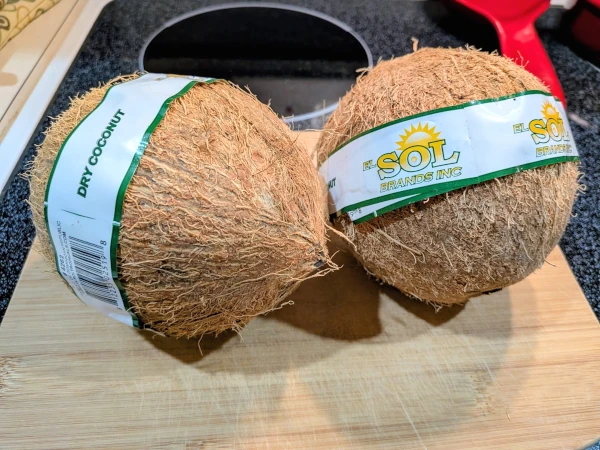
The guides I found online weren’t very consistent on how much a single coconut would yield; one suggested one cup, while a second suggested two. That’s kind of a huge difference that’s difficult to reconcile; but I figured if I needed 125 grams of desiccated coconut and a cup was 80 grams, it would probably be safer to buy two coconuts.
With coconuts in hand (stop giggling, this is a serious blog), my next task was figuring out how to open the damn things.
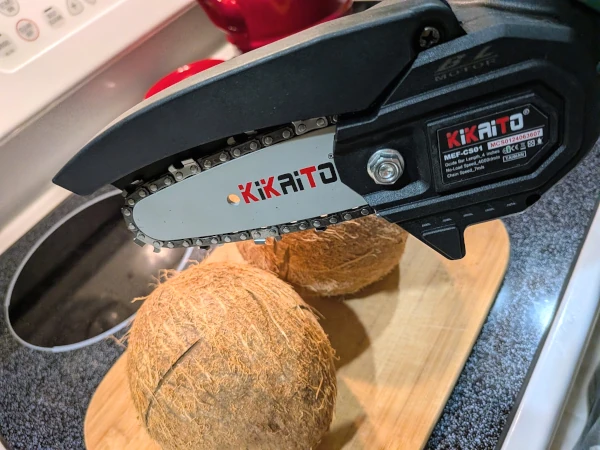
Pretty much every YouTube video I watched regarding this matter recommended whacking it along the equator with a heavy blunt object, like a hammer or the backside of a cleaver (off-topic, but why don’t I own a cleaver, the most badass of all knives???). The videos make it look easy, of course, splitting the shell with a small series of measured taps.
Meanwhile, I whacked at that first coconut for a good ten minutes with a hammer before I got it to crack, and only then after I got desperate and switched to the claw end that pulls out nails.
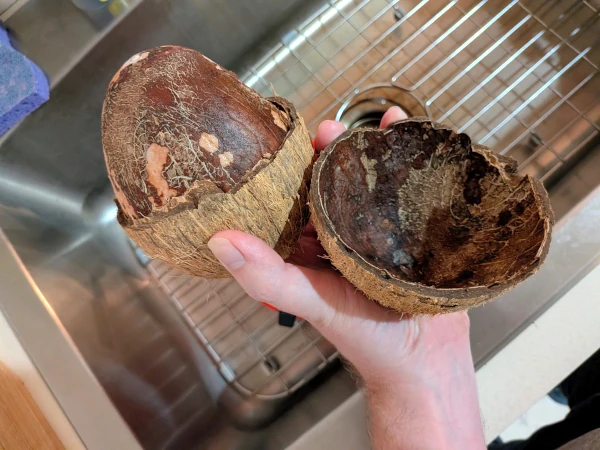
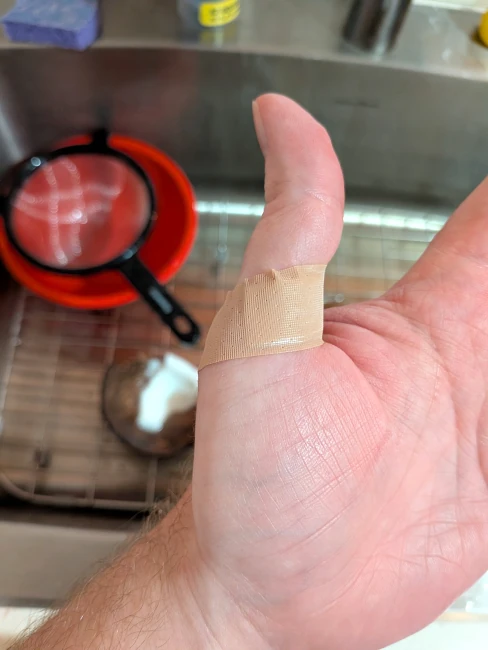
I still wasn’t done, though, because I had to remove the second half of shell; it didn’t pop off like the first half. One of the videos had told me to do more hammering to loosen the meat from the shell, then pry it out with a knife. That’s what I tried, but a portion of the meat refused to relinquish its death grip on the shell, and the next thing I knew I was learning why oyster shuckers tend to wear gloves.
Coconut #2 cracked much quicker since I started out with the claw-end technique this time. However, rather than risking stabbing myself again getting the shell off, I decided to try another approach I’d seen in a video: baking the coconut halves in the oven for a few minutes.
This method wasn’t a walk in the park, either. I still ended up hammering the shell all to hell afterward, breaking it apart and sending bits flying all over my kitchen in order to release the meat, though at least this time I managed to escape further injury.
The next step was to peel the brown layer of skin coating the outside of the meat. In theory, you’d just use a vegetable peeler, easy-peasy. Well as it turned out, the skin on the coconut I’d baked must have dried out from the process or something, because I sunk the peeler in that thing and the peeler met so much resistance that it instantly resigned from its post. Even my freshly-sharpened chef’s knife was meeting so much resistance near the edge that, short of cutting further in and wasting a ton of meat (and having no clue how much I could feasibly sacrifice), I had to first cut the coconut into thin slices before I could trim off the skin. No joke, it took me 40 minutes to skin this coconut. This might have been a good job for a cleaver, if I’d had one.
Anyway, the one I didn’t bake was fine. Five minutes with the peeler, tops.
From there, I just had to blend the coconut and dump it onto a baking sheet so I could put it in the oven and dry it out. For some unknowable reason, my blender—the cheapest option sold by Target a decade ago—isn’t really the best at chopping, so I had to pick out a few of the larger chunks. I would continue to do this regularly throughout the drying process.
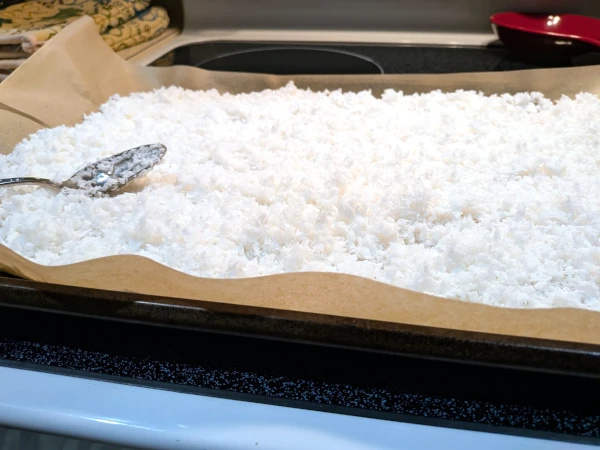
The desiccated coconut recipe I was following said to bake for an hour at 140°F. My oven doesn’t go below 170°, but that turned out to be okay because I had so much coconut piled up on the tray that it ended up taking way longer than an hour. I forget exactly how long it spent in the oven, but despite how much of the afternoon I’d taken with the coconuts already, there was at least an hour before we had to leave for our evening salsa class; then we came home and I gave it probably another 30–45 minutes before bed; and then I had to leave it sit out overnight and did maybe another hour Saturday morning.
It’s a lot of coconut, sure, but better check to make sure I’ve got enough:
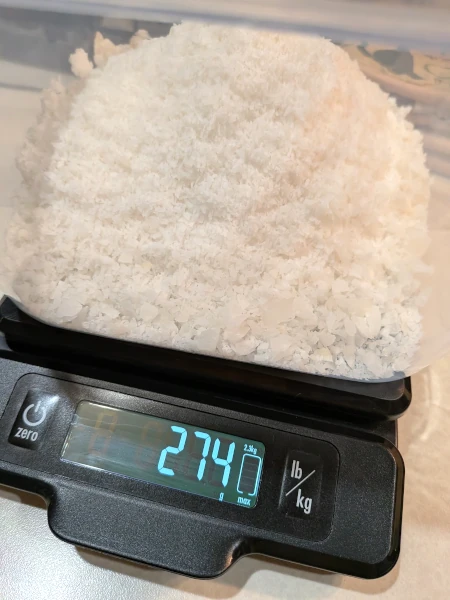
…More than twice what I needed. Yeah, that figures.
Saturday
“Well, at least baking a cake will be easier,” I told myself on Saturday morning. “I know how to bake a cake.”
“In fact,” I continued to tell myself, “I know that I’m probably supposed to put icing between these two layers of cake and stack them, even though the recipe doesn’t include that as a step. Isn’t it a little weird that the recipe doesn’t include that step? Isn’t it also a little weird that the cake in the photo kind of has three layers instead of two, maybe, it’s really hard to tell because the layers are indistinct? Shouldn’t the layers be more distinct? Like, shouldn’t the icing between the layers be the same color as the icing on the exterior because there’s only instructions for one icing?”
“And while I’m at it, isn’t it weird that this site is called Mary Berry Cooks but the author of this post isn’t Mary Berry? And doesn’t the author’s profile photo look a little funny, sort of like it’s been… AI… generated…… Well. Shit.”

I guess somebody out there is having a real go at slapping Mary Berry’s name and some generated text on the same Wordpress template and pushing it to multiple domains, because it turns out this is not the only example of this. Hell, this site has posted over six hundred pages, all with “Mary Berry” called out in the title. Should I have clocked that this site wasn’t legitimate when I received the recipe six months ago? Probably. I guess this is what I get for trusting links sent by strangers on the internet.
(Note to P7uen: I’m not mad. This was actually a very funny development.)
It’s possible that the recipe itself is real, of course, but at this point I simply couldn’t trust it—not for baking, anyway, which is an art that demands precision. If ChatGPT assumed that 300 grams of flour sounded equally as plausible as 500 grams because it doesn’t actually understand what the hell baking is, my whole adventure would over; except I wouldn’t actually find out until two or three hours later when I was looking at a tragedy of a cake wondering where it all went so wrong. So I needed a new recipe, and I needed it quick.
I assume Mary Berry does have a coconut cake recipe that’s floating around out there in the ether, but it’s probably exclusive to some cookbook so her publisher can make money off of it. My searches returned plenty of references to Mary Berry’s coconut cake—this was how I found out how many of these AI sites exist, though some seemingly-human sites mentioned it too—but finding an actual recipe I could put my faith in while avoiding an impromptu trip to the grocery store proved something of a challenge.

My holy grail came from Rachel’s Recipe Pantry. In terms of ingredients and process, Rachel’s recipe is quite similar to the one I’d seen originally, furthering my belief that these do share a common ancestry of some sort. But there were some encouraging details here: lemon icing swapped for buttercream frosting. A picture of the pre-frosted cake still in its pan. An anecdote that the author also tried the recipe in an air fryer. A photo of the final result that turned up no duplicates on a reverse image search (I had to be sure!). Added up, all these details say: it is almost a certainty that a human successfully baked this cake.
And so I set to work.
Step one, prep the cake pans. A few years ago I bought a pair of springform cake pans specifically to make layered cakes. The second time I ever used them, I found that they both leaked batter. Now I have to fuss about and line the pans with parchment paper whenever I want to use them, which is basically never because I hate trying to line the pans with parchment paper. I regret these pans but I will feel guilty about generating waste if I ever dispose of them.
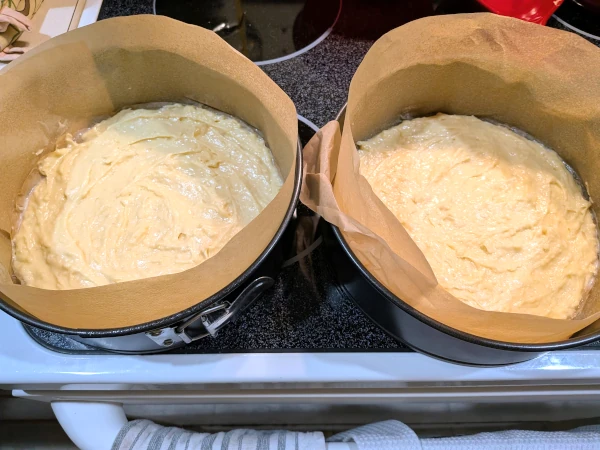
With that done, I can start mixing ingredients together. I’m already starting off on the back foot here, because the recipe calls for caster sugar—common to the U.K., but apparently illegal to possess in the States because nobody sells it. It’s finer than regular-ass sugar, but not as fine as powdered. The solution was to just toss regular sugar in the blender to chop it into smaller grains. It seemed to work.
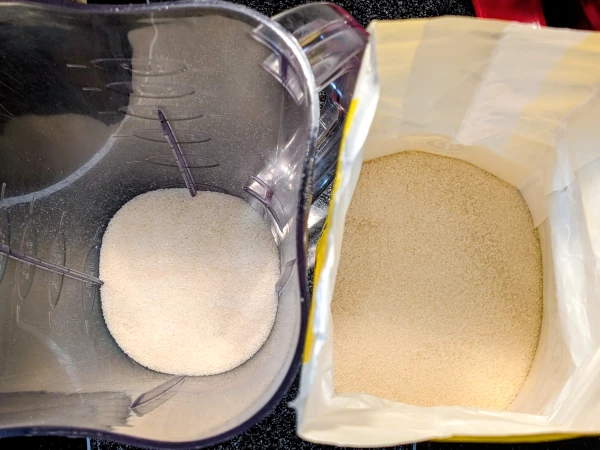
I almost had a second similar hiccup: the recipe specifically calls for self-rising flour. I’d never heard of this; it’s associated with the southern U.S., so it seems a bit weird to find it in a British cake recipe, but whatever. From the name I assumed it was just flour with baking powder in it, and I was pretty much correct. I was perfectly ready to make my own, but the recipes for homemade self-rising flour noted that I’d probably have to add more liquid to the cake mixture or else the end result could be denser than usual. Well that’s annoyingly vague. How much wetter does the batter need to be? Do I just wing it? If I was interested in winging this thing I’d be using the AI’s recipe.
But since I’d needed to go grocery shopping to pick up coconuts and the like, I figured it couldn’t hurt to look for self-rising flour too. I first tried the store that specializes in organic everything and has fifty types of flour, like almond flour and quinoa flour and chickpea flour and all that weird stuff that somebody in my local area must be buying, though I can’t fathom who because I’m rural enough that the dominant cuisine in these parts is “cow”.
Despite possessing more flours than I will ever know what to do with, they did not sell self-rising. You know who did: my neighborhood chain grocer. Though nowhere near as extensive as the organics retailer, they’re offering a tidy little selection of flours these days. I find this rather impressive as just two years ago their baking aisle only contained all-purpose, and maybe bread flour if they were feeling particularly frisky that week.
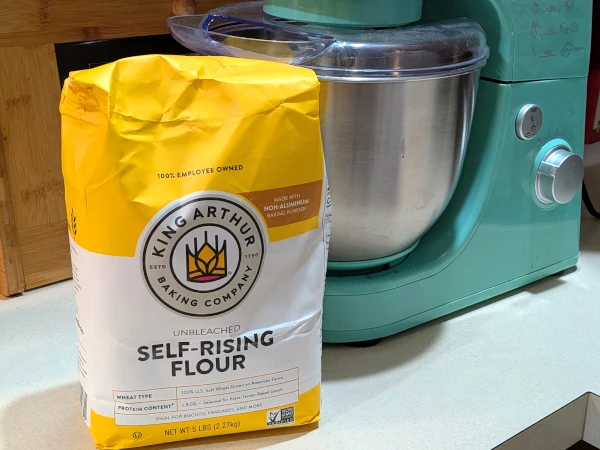
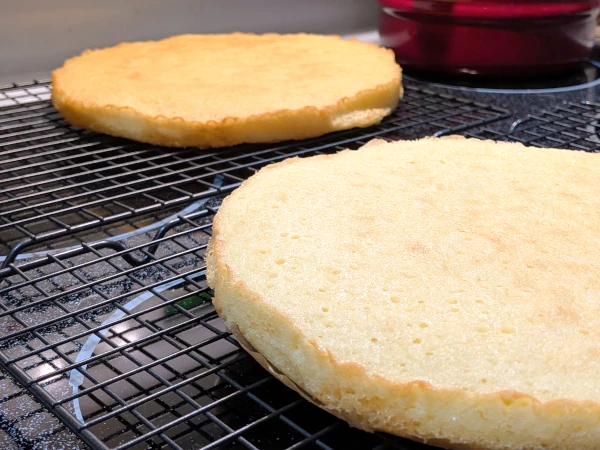
Returning to the coconut cake, things were progressing rather smoothly at this point, and indeed there isn’t much left to report. Like I said: I know how to bake a cake. I was very pleased with how light and airy the sponge looked coming out of the oven; I don’t think they could have turned out any better. Thanks, self-rising flour that I now have to figure out how to use an entire bag of!
As I mentioned earlier, Rachel’s recipe had instructions for a coconut buttercream frosting. I wasn’t keen on this, partly because I didn’t want buttercream for this cake and partly because it required coconut milk, which I didn’t have as I was unaware I’d be using this recipe today. The recipe from the AI site instead used an icing that was made from lemon juice and powdered sugar. I’ve made this icing before and it’s so dead-simple that not even ChatGPT could screw it up, so I decided it was worth trusting in this case. Really, the only issue I encountered was simply not having enough icing, and needing to whip up two more batches before the cake was sufficiently sugary.
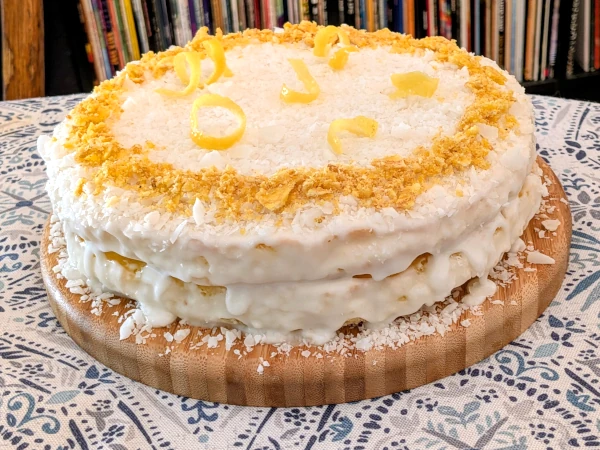
Lastly, I covered the cake with the desiccated coconut. For garnish, I added a bit of lemon peel as well as some crushed plantain chips. I was originally thinking banana chips, but I saw the plantain chips at the store and couldn’t help but marvel at how vibrantly yellow they were. The data centers of my brain do possess the knowledge that bananas and plantains are not the same thing and don’t taste at all alike, but somehow this information becomes completely inaccessible to me when I’m actually confronted with plantains. Fortunately their flavor is so mild that the small amount I used was completely inoffensive as decoration here.
And with that, the cake was complete, and all that was left were many, many dishes to clean.
The Verdict
Overall, this was one of my most successful bakes. I can see why the OG recipe is popular; there’s enough flavor to be satisfying without being too overwhelming for somebody who doesn’t enjoy coconut. I do have to cut Pepperidge Farm some slack: although I avowed months ago that their sponge contained no trace of coconut, the flavor of coconut was also difficult to detect in my own, and I know damn well mine had it. I officially recant my statement and offer no opinion on whether they are or are not misrepresenting their product.
If I made this cake again, I might swap the lemon icing glaze for a fluffier vanilla frosting. I like frosting, and I think it would provide better visual appeal, filling in the gap between cakes more cleanly. You can’t really tell in the finished product, but I did put icing between the cake layers; I guess it all got absorbed into the sponge. Not a big deal in the end, more of a very, very minor disappointment.
As for lemon versus vanilla—I didn’t think the lemon flavor was bad per se, but it did overwhelm the coconut to some extent. Less than ideal since this is supposed to be a coconut cake. On the other hand, Mrs. Skep actually loved this result, since she isn’t as tolerant of coconut as I am; so, take that how you will. I did encounter an odd delight, though: as the week passed and cake aged, the lemon flavor actually weakened, and the coconut became stronger by comparison. I’m kind of enjoying it more a few days past its prime than I did when it was fresh-baked because I’m actually getting the taste I wanted. Funny how that works sometimes. I still think vanilla would have sidestepped this discrepancy though.
To put a cap on this post, all I can say is: yes, I think I’m going to add this recipe to my repertoire. It’s a really good cake! Except I’m just buying shredded coconut from here on out.