Gaming Report Q4 2025
I didn’t quite realize just how big the discrepancy was between how many games I played this year versus last year, but boy, my Steam recap really put me in my place—41 games in 2024, versus 21 in 2025. Half as many! I don’t feel like I’m playing any less; I think I’m just getting absorbed in longer games. Maybe I’ll look back upon 2025 as the year of the time sink. Anyway, here’s how the last quarter went.
Tchia
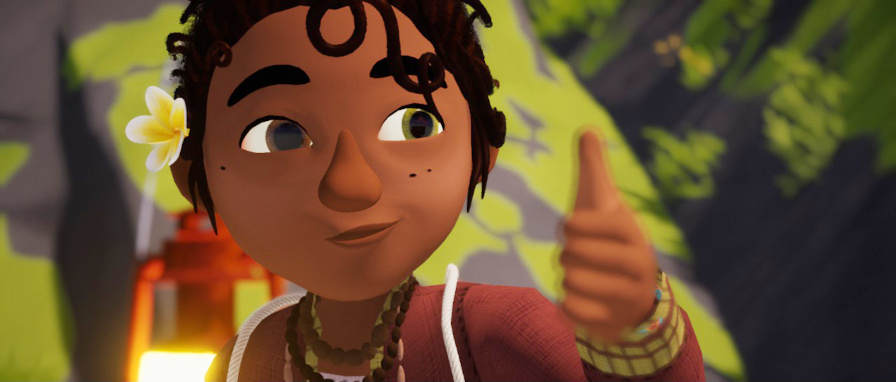
I took my time getting all the collectibles and completing most of the activities (the shooting galleries are 100% bullshit). The sheer amount of unlockable clothing is delightful and lets you give Tchia all kinds of looks, although because they tied clothing to stats, you don’t really have as much freedom as you’d like here (especially since not all stat boosts are equally useful).
Also, weirdly violent in places for such a cartoony presentation? It wasn’t overdone or anything, just felt out of place when it did occur. Most of the time though, I found it to be a charming way to unwind in the evenings. The cutscene animations were tremendously well done, and I loved every single time the game decided “okay, now we’re going to have a music scene”. I’d play it again just for those.
Korter 1996
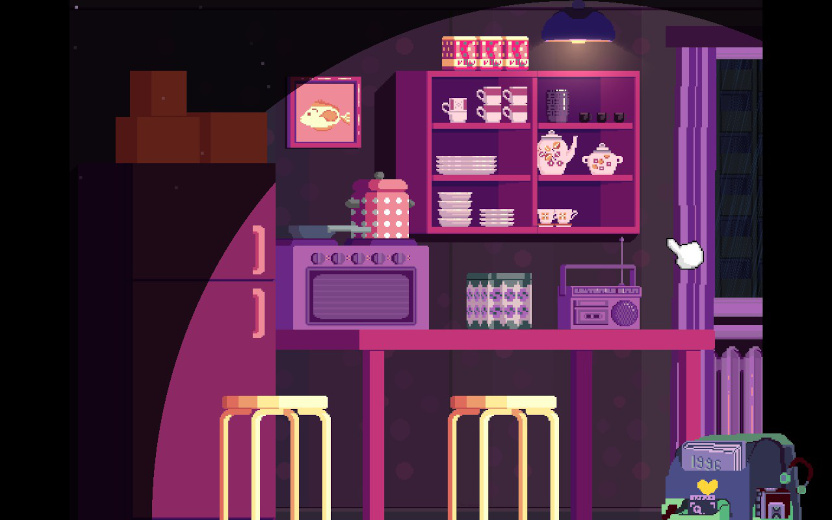
I found this game via its Neocities site! I would call it a… point-and-click puzzler, perhaps? You explore some of the apartments in your complex, collecting and repositioning items here and there to ascend further in the building. It’s got some vibes that are slightly retro and soothingly surreal. And… yeah, maybe it’s a little obvious that I played this one two months ago and I’m already having difficulty recollecting it. It has a short runtime—perhaps too short to have left a lasting impression on me. It’s absolutely not a bad game, and I would say in this case, don’t judge it off of what I’m saying because clearly I don’t know what the hell I’m talking about. Go check out an indie project from a small team and see if it might be for you!
Rift of the Necrodancer
I did play Crypt of the Necrodancer, and gosh it was hard. As much as I wanted to, I could never really get the rhythm of the game down, and none of my runs made it very far. I wanted to like it, though.
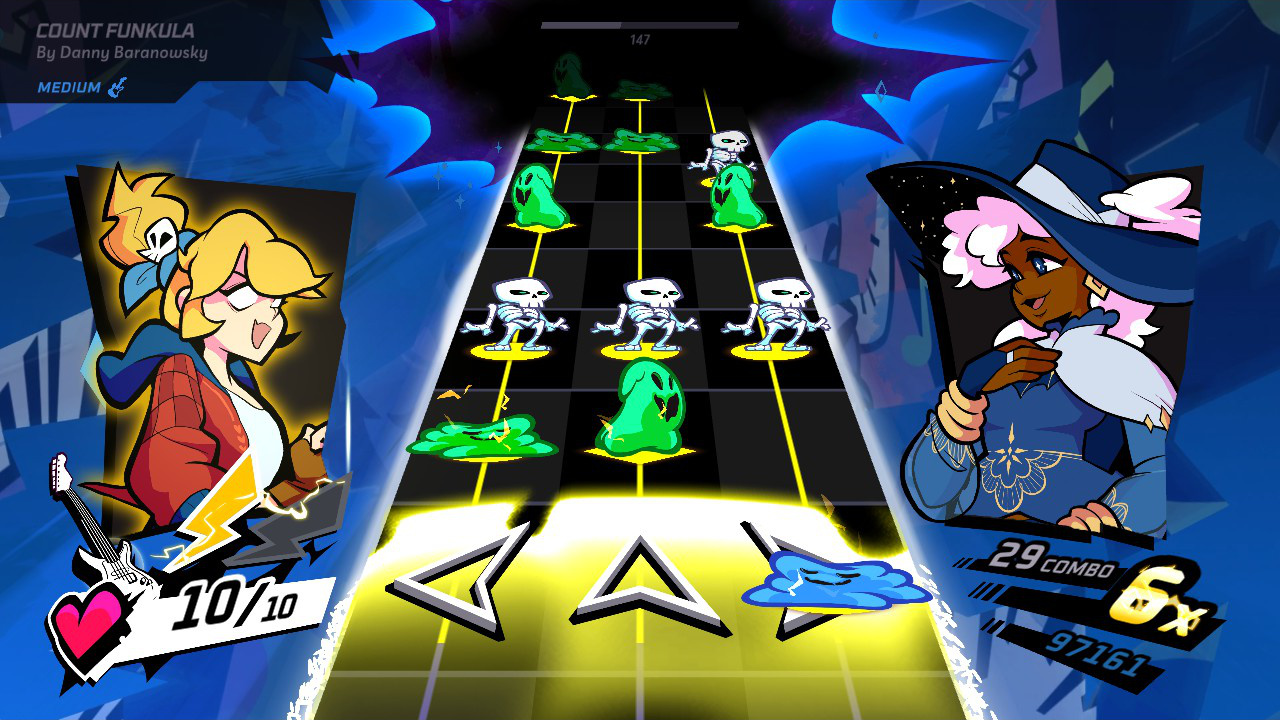
Rift of the Necrodancer, rather than being a rhythm-based roguelike, has more in common with Guitar Hero. Well hell, I played Guitar Hero on Expert difficulty back in the day, I should be able to pick this up pretty easy.
…But gosh, is it hard. It’s not as simple as just hitting the notes as they reach the bottom, because now the notes like to jump around the fretboard. You have to memorize a dozen or so different movement patterns, which are represented by the different enemy types (to say nothing of the additional effects you encounter sometimes that can alter how an enemy behaves). Even on Medium difficulty it’s so chaotic that if I’ve had a whiskey, I simply can’t play it.
Unfortunately, I suspect this might end up like its predecessor: a game I want to like, but which I have no desire to put in the effort to get to the point where it becomes enjoyable. We’ll see.
Apollo Justice: Ace Attorney Trilogy

Another step in my quest to play through the Ace Attorney series for the first time. At this point, I’ve completed the first two entries in the trilogy (Apollo Justice and Dual Destinies). Largely, more of the same good stuff! We do have some cracks starting to show though.
In the original trilogy, Phoenix received the Magatama by game 2 as a way to inject a bit of the evidence-driven deduction-making gameplay into the slower-paced clue-finding phase, and this was good. But because our protagonists need equivalent special gameplay-altering abilities now I guess, in Apollo Justice, Apollo just shows up on his first day wearing a magical bracelet that lets him easily see “tells” that indicate a witness is lying. It’s kind of justified late in the game, but before then, there is exactly zero reverence for this fascinating piece of jewelry, and it is absolutely bizarre at how little attention it receives in-universe. Also, the gameplay it adds is pretty bad; the game hyper-zooms in on the witness as they slowly repeat a statement, and during one part of that statement, one part of their body will behave differently—the “tell”. This sucks; the camera is so zoomed-in that you can only cover maybe a quarter of the witness’s body at once, and you might only have a couple seconds to drag the slow camera around and identify the tell during the few words that it’s visible. If you miss it, you have to cycle through the entire slowed-down statement again and hope you find it this time… all of which is assuming you’re examining the correct statement to begin with. I guess the developers wanted a way to be able to advance the courtroom scenes without needing evidence all the dang time, but this is such a bad solution because it’s not asking the player to challenge their assumptions (you know, the best part of the game); it’s more like an elaborate spot-the-difference puzzle.
They at least do it a little better when they bring in Athena in Dual Destines. Her ability to analyze a witness’s moods during testimony is, you know, a thing she studied how to do, and identifying anomalous emotions is at least asking the player to think critically about the information being presented to them, so I don’t hate it. Still, both of these abilities only take place during the courtroom scenes, and the Magatama is used incredibly sparingly in the clue-finding phases, so those are still boring as heck.
My biggest complaint, as I said with The Great Ace Attorney Chronicles, is that these cases get so dragged out. I don’t think these games need to be this long. I still like them, but I will sit down with the expectation that I’m close to the end of a case and I’m going to finish it, and then by the end of my play session it’s still not done. That is so frustrating. Anyway I’m going to take a break and come back to Spirit of Justice later.
Oblivion: Remastered
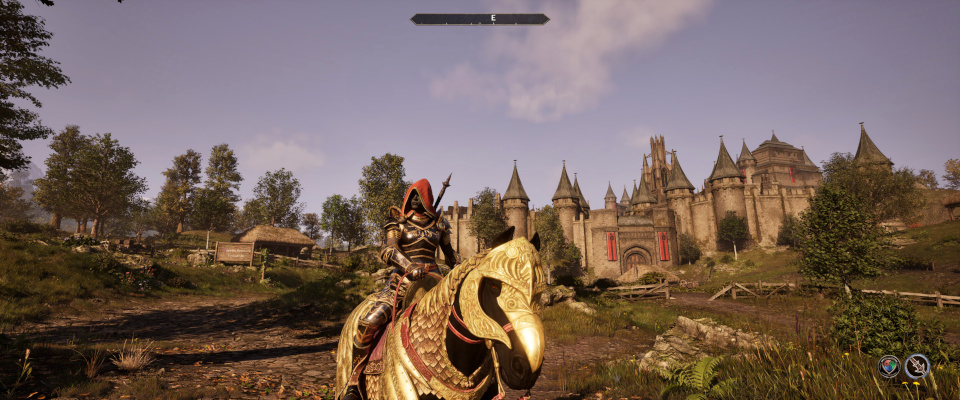
Gosh, I’m really not used to talking about the same game three quarters in a row. Well, let’s see. Just today, I wrapped up the main quest and all the faction questlines. Nothing much but DLC left. So that’s pretty exciting.
One of the things I don’t like about Bethesda’s style of RPGs is that they are so unfocused and sandbox-y that your character doesn’t feel like a real entity. The world exists to cater to you. The NPCs all feel like NPCs. Things like that. Calling them “RPGs” is honestly a bit of a misnomer, because you are playing the absolute barest hint of a role. I could go on, but I won’t. What I will talk about is, although I wouldn’t say my current Oblivion character has an interesting story, per se, she definitely went through an arc this quarter, and that was kind of fun to experience.
See, my bitter and exhausted mercenary slowly began to discover that overwhelming destructive magic was a far more effective means to solving her problems than a sword was, and after joining the Mage’s Guild, she was using spells to take down her enemies with brutal efficiency. She stopped feeling weary, and began to feel empowered. Eventually, a few different side quests coincidentally brought her in contact with a number of different vampires, and she began to grow enamored with thoughts about how such a transformation might enhance her own power. So, she becomes a vampire herself (an act that I have painstakingly gone out of my way to avoid for years, ever since vampirism traumatized me on my very first playthrough).
Keeping a nocturnal schedule was annoying but manageable. Being outright shunned by most people she tried to talk to was honestly a bit vexing, but she could look past that. No, it was a singular incident that broke her: spending 14 hours of daylight holed up in an insect-riddled cave, at what should have been the absolute height of her inhuman power, all because her body wouldn’t tolerate a goddamn sunbeam anymore.
So, I immediately proceeded to do the Cure for Vampirism quest. At least it’s a lot easier to do at level 30 than it is at level 4. Ask me how I know.
For next quarter: Like I said, I’m taking a break from the Apollo Justice Trilogy to work through Mosaic of the Strange, the newest entry in the Mosaic series of games I’ve highlighted a few times. With any luck, I’ll finish Oblivion in the next few months. After that, I really don’t have anything planned despite the backlog piling up… so I suppose we’ll see what the new year brings!